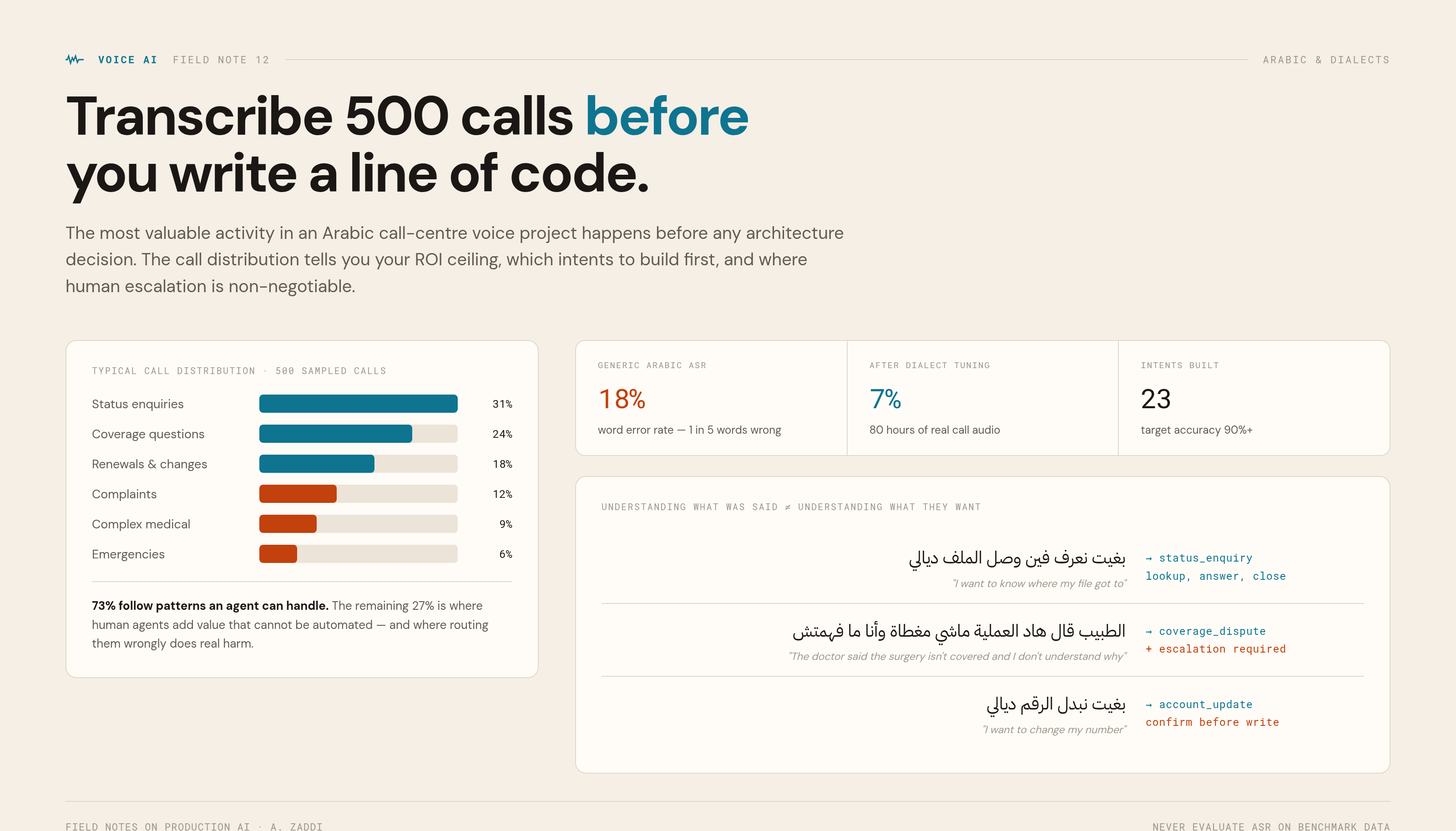
Pull a random sample of calls and categorise every one. That single exercise tells you your ROI ceiling, which intents to build first, and where human escalation is non-negotiable — and it costs a few days rather than a few months of building the wrong thing.
The distribution decides the roadmap
In a typical centre, around 70–75% of calls follow patterns an agent can handle. The remaining quarter is where humans add value that cannot be automated, and routing those wrongly does real harm.
Dialect-specific transcription is not optional
Generic models trained on one variety of a language perform poorly on others. A generic Arabic model might sit around an 18% word error rate on regional dialect call audio — roughly one word in five wrong, which destroys every downstream intent decision.
Collecting real call recordings and tuning on them can bring that to roughly 7%, which is workable for most intents. The method matters more than the number: record your own calls, transcribe a sample by hand, and test every candidate model against that — never against a benchmark dataset.
Intent matters more than transcription
Understanding what someone said is not the same as understanding what they want. “I want to know where my claim is” is a status enquiry. “The doctor said the surgery isn't covered and I don't understand why” is a coverage dispute *and* an escalation. Same language, different backend call, different outcome.