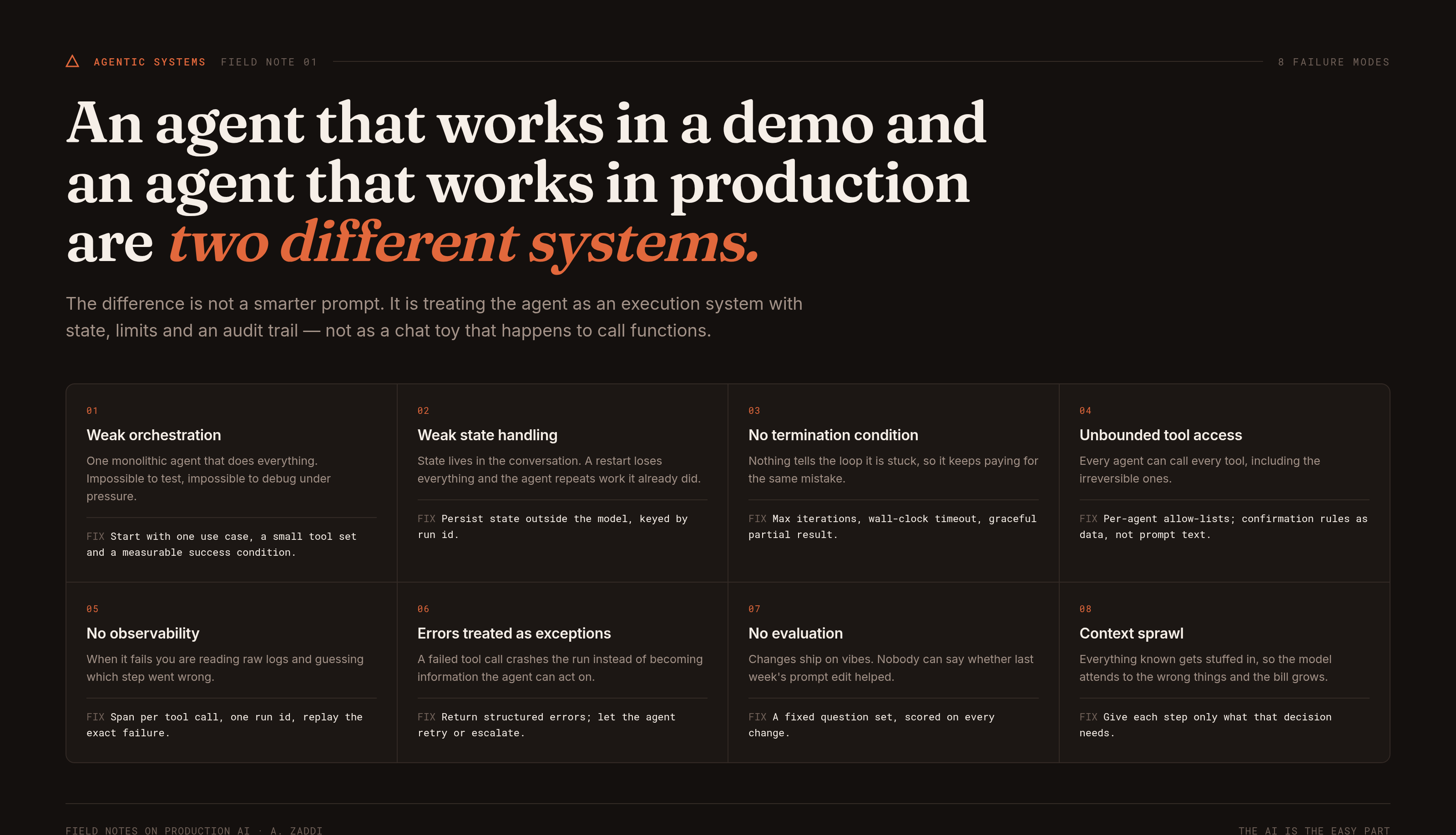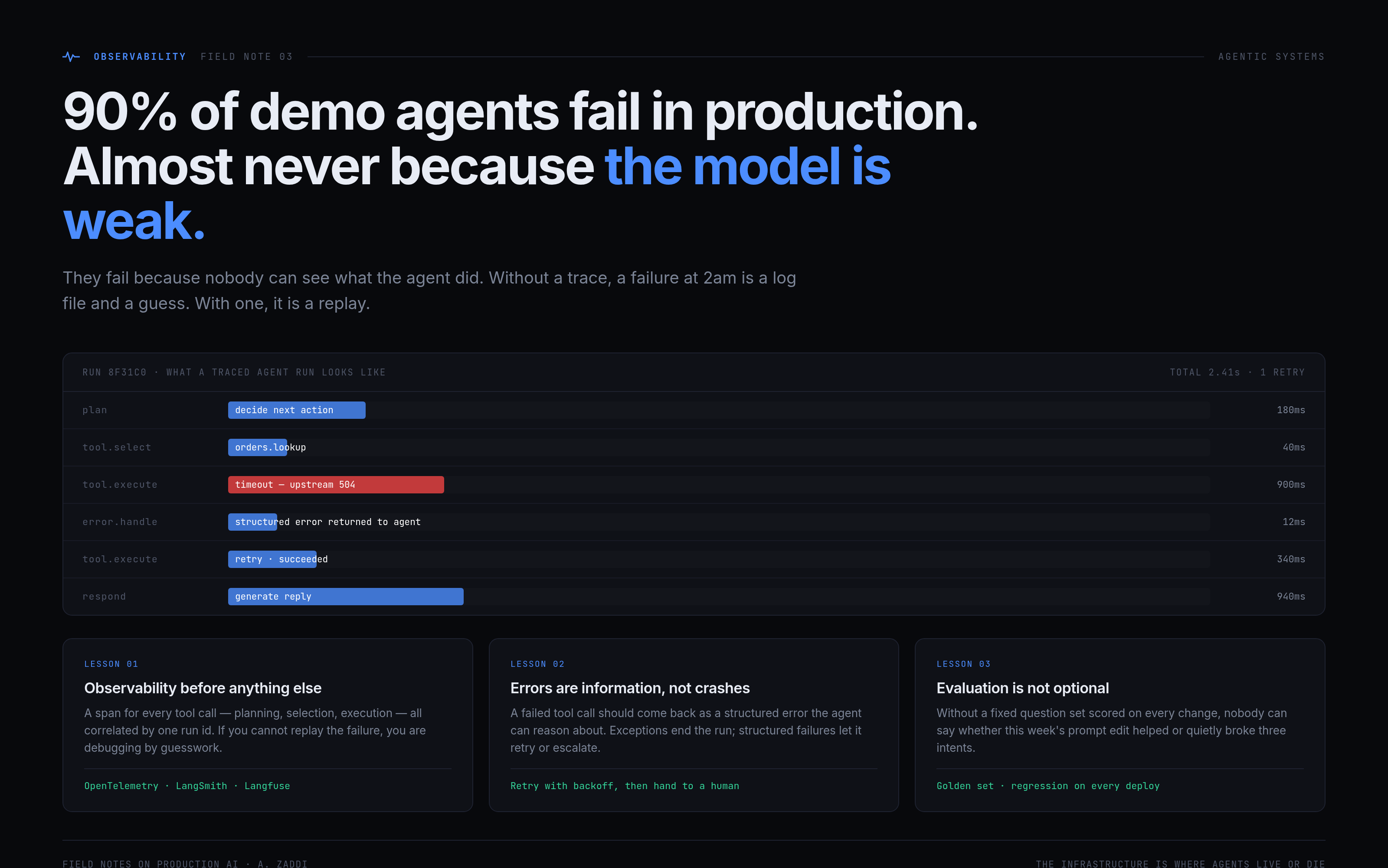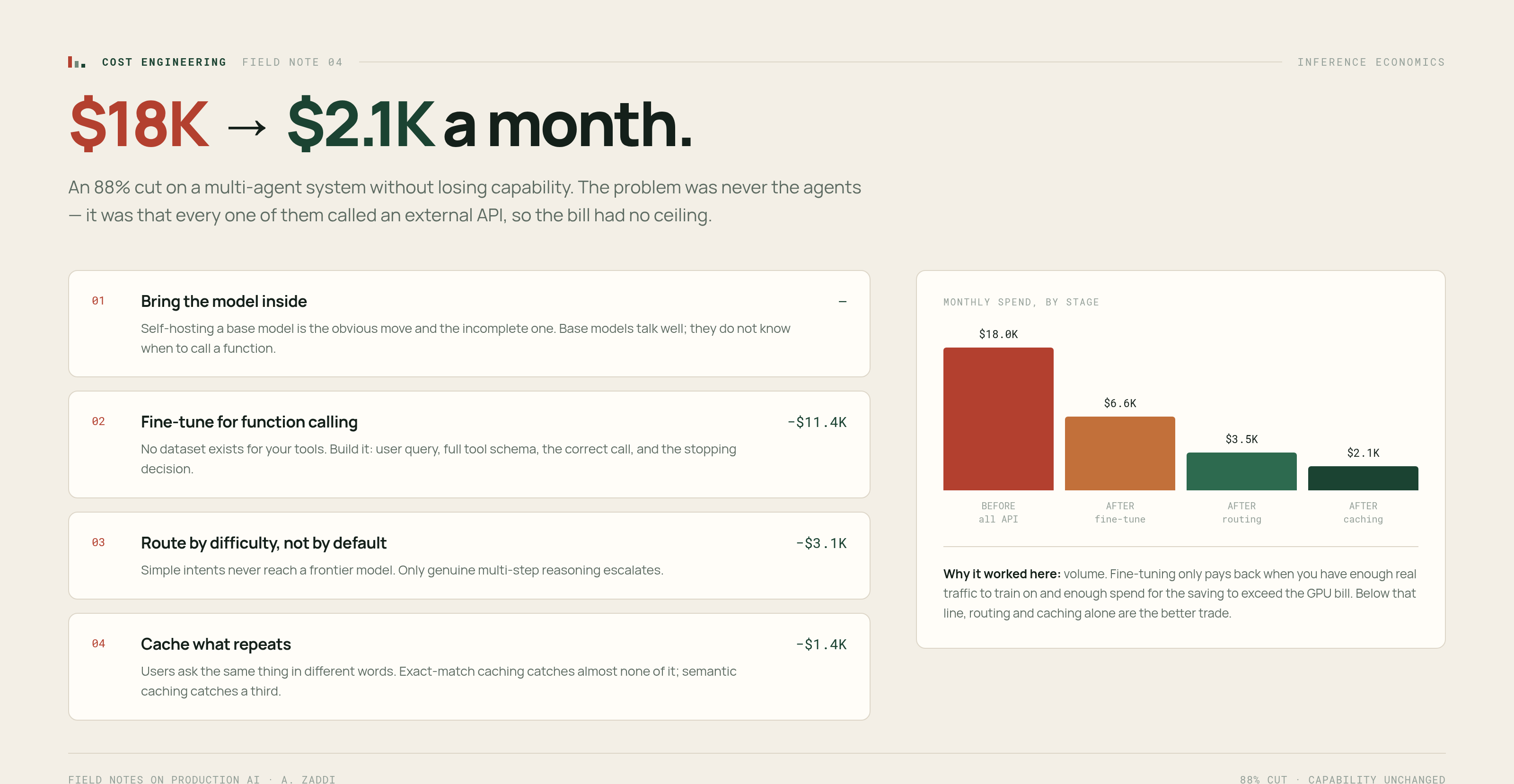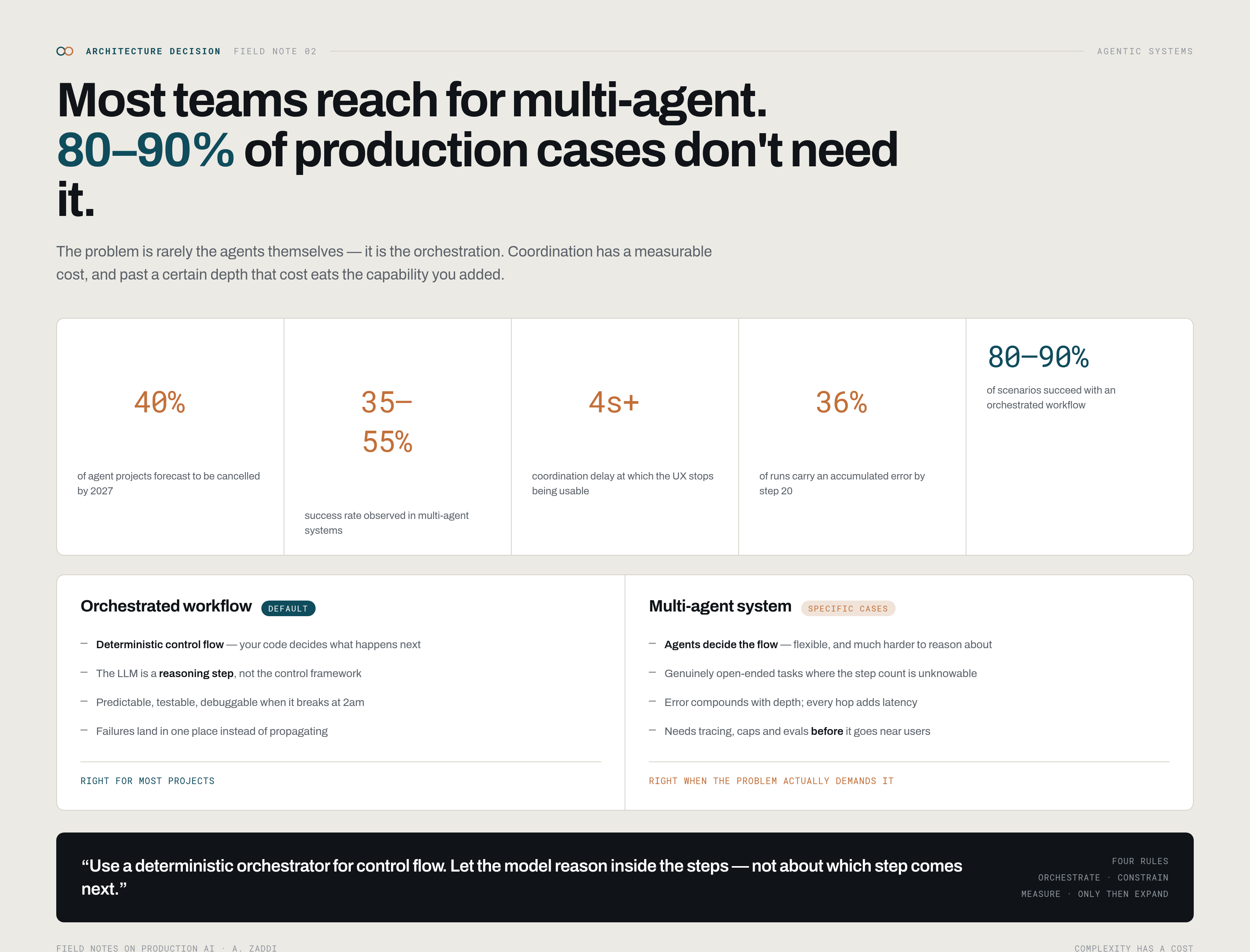
The problem is rarely the agents themselves — it is the orchestration around them. Coordination costs latency, and errors compound with depth. Both are measurable, and both argue for reaching for the simpler shape first.
The numbers that should inform the decision
- —Roughly 40% of agent projects are forecast to be cancelled by 2027.
- —Multi-agent systems report success rates in the 35–55% range.
- —Coordination delay above about 4 seconds makes the experience unusable.
- —By step 20, more than a third of runs carry at least one accumulated error.
That last figure is the one that matters most. In a 20-step chain, error accumulation is not an edge case — it is the median outcome. Complexity has a price, and it is paid per step.
Orchestrated workflow as the default
Orchestrated workflow
- Deterministic control flow — your code decides what happens next
- The model is a reasoning step, not the control framework
- Predictable and testable
- Failures land in one place
Multi-agent system
- Agents decide the flow — flexible, harder to reason about
- Genuinely open-ended tasks only
- Error compounds with depth; every hop adds latency
- Needs tracing, caps and evals before users see it
Somewhere between 80% and 90% of production scenarios are served by the left-hand column. That is not a limitation to apologise for — deterministic control flow is the reason the system stays debuggable when it misbehaves at 2am.
Four rules if you do orchestrate
01OrchestrateControl flow lives in code. The model fills in the reasoning inside a step.
02ConstrainEach step gets the smallest tool set and the smallest context that will do.
03MeasureTime every step separately before optimising any of them.
04ExpandAdd agent autonomy only where profiling shows the deterministic version cannot work.