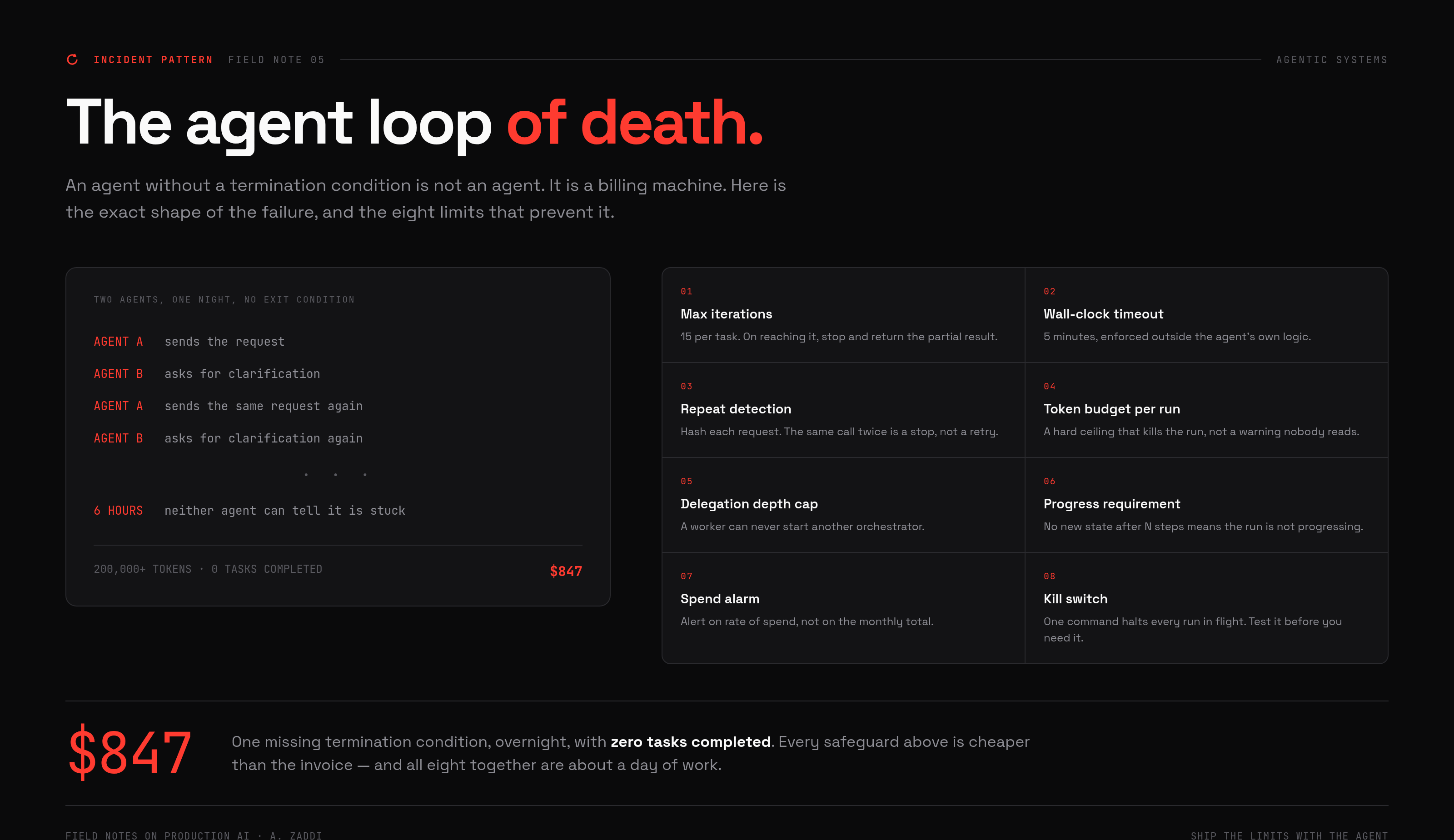
The failure is simple and expensive. Agent A sends a request. Agent B asks for clarification. Agent A sends the same request again. Agent B asks again. Neither has any way to notice it is stuck, so the exchange continues until someone looks at the bill.
$847
what an unbounded overnight loop can cost, with zero tasks completed
Left running for six hours, that shape burns through 200,000+ tokens and completes nothing. The root cause is always the same: no agent in the system had a clear termination condition, so the system had no way to know it was failing.
Eight safeguards that prevent it
01Max iterationsA hard cap — around 15 per task. On reaching it, stop and return the partial result.
02Wall-clock timeoutAround 5 minutes, enforced outside the agent's own logic.
03Repeat detectionHash each request. The same call twice is a stop condition, not a retry.
04Token budget per runA ceiling that kills the run, not a warning nobody reads.
05Delegation depth capA worker can never start another orchestrator.
06Progress requirementNo new state after N steps means the run is not progressing.
07Spend alarmAlert on rate of spend, not on the monthly total — the monthly total arrives too late.
08Kill switchOne command halts every run in flight. Test it before you need it.